Quick answer
A rental hot tub needs its water tested and balanced at every turnover, a filter swap or rinse every few days of use, a drain and refill every few weeks to few months depending on how many people soak, and a cover that gets replaced every few years. The yearly cost depends on your tub and bookings, so build it from your own quotes.
Groups use a hot tub harder than a household does, so the routine matters more.
Key takeaways
- A rental hot tub needs a water test and adjustment at every turnover, plus a check during longer stays; the CDC recommends testing chlorine and pH at least twice a day and more often with heavy use.
- CDC targets for hot tubs are at least 3 ppm free chlorine and pH 7.0 to 7.8, and it advises against cyanuric acid in hot tubs.
- Group use shortens water life: Jacuzzi's drain formula divides gallons by daily bathers, then by three, so a busy rental can need fresh water every few weeks.
- Keep a second filter cartridge so one can soak while the other runs; Sundance suggests rinsing every few days and deep cleaning every 2 to 3 weeks for rentals.
- Budget for chemicals, filters, water and power, a cover every few years, and repairs to the things guests break most: covers, lifters, headrests and controls.
In this guide
Water care between groups
The answer is to test, shock and rebalance at every turnover, and to check the water during any stay longer than two or three nights.
The CDC's guidance for home pools and hot tubs says owners should "test chlorine concentration and pH at least twice per day," and more often when the tub "is being used by a number of people." A rental with a new group every few days is exactly that case. Nobody visits a rental twice a day, so most owners split it: a full test and adjustment at turnover, and either a mid-stay visit or a remote water monitor for longer bookings.
The CDC targets for hot tubs are simple:
| Measure | CDC recommendation for hot tubs |
|---|---|
| Free chlorine | At least 3 ppm |
| pH | 7.0 to 7.8 |
| Cyanuric acid | Not recommended in hot tubs, including chlorine products that contain it |
| Test method | DPD test kit for the most accurate result; test strips are allowed but less accurate |
Two details from the same CDC page matter at a rental. First, a very high chlorine reading can fool you: above 10 ppm, the test can "bleach out" and read falsely low or zero, which tempts a cleaner to add even more. Second, as pH drops below 7.0, chlorine kills germs faster, but pipes and parts corrode. Keep pH inside the range rather than chasing a low number.
A turnover routine that works
- Remove the cover and check for debris, hair and anything left behind.
- Pull the filter and swap in the clean spare.
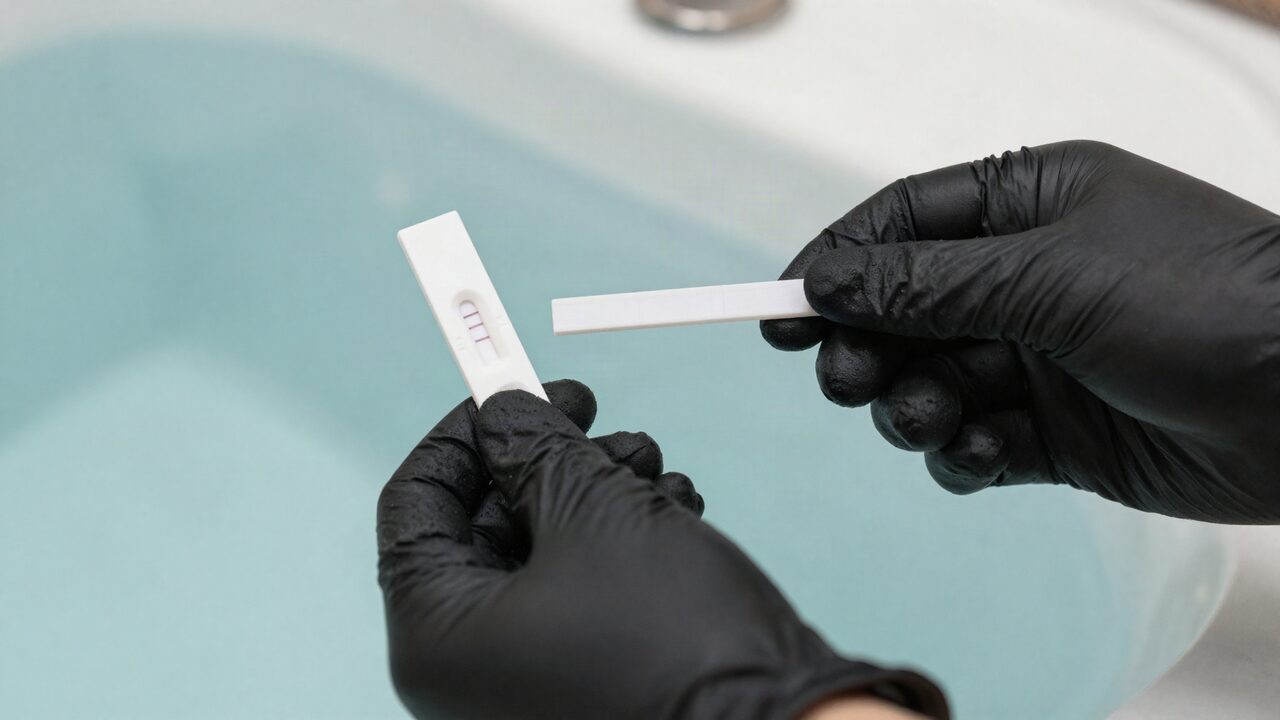
- Test free chlorine and pH with a DPD kit.
- Shock the water to break down what the last group left, following the product label.
- Run the jets with the cover off for the time the product calls for, then retest.
- Wipe the waterline and the cover underside.
- Rebalance pH, confirm chlorine is in range, close and lock the cover.
- Log the readings and the photo.
Chemicals and test supplies
The answer is a short, consistent kit kept locked on site: a sanitizer, a shock, pH up and down, and a reliable test kit.
Chlorine is the default because the CDC targets are written for it and it works quickly after a heavy group. Some owners use bromine instead; if you do, follow the tub maker's guidance and your local rules, since the CDC page sets its hot tub number for chlorine. Mixing systems causes trouble, so pick one and train everyone who touches the tub on it.
Keep the kit locked. Guests who find a bucket of chlorine and decide to "help" can push levels far out of range. The CDC page is blunt that the owner is responsible: "it is your responsibility to regularly check the chlorine concentration and pH of the water."
What to stock for a rental:
- Sanitizer (chlorine granules or tablets without cyanuric acid, or bromine if that is your system)
- Non-chlorine or chlorine shock
- pH increaser and decreaser
- Alkalinity increaser
- Defoamer for the occasional bubble bath incident
- DPD test kit plus strips for quick checks
- Filter cleaner for deep soaks
- Gloves and eye protection for whoever doses the water
Filters: keep a spare
The answer is two cartridges per filter slot, rotated every few days of use, with a deep clean every two to three weeks.
Sundance's filter guide gives a standard schedule of a rinse "every 7 days," a deep clean "every 4 to 6 weeks" and replacement "every 12 to 24 months." For rentals and heavily used spas it suggests "a rinse every few days and deep cleaning every 2 to 3 weeks." It also recommends a second cartridge so "one can be in service while the other soaks or dries."
At a group rental that spare is not optional. A filter clogged by sunscreen and body oil cuts flow, the water goes cloudy, and the next group arrives to a tub they won't get into. Swapping filters at turnover takes a minute; soaking the dirty one happens off site or between stays.
Drains and refills
The answer is to drain on a schedule set by how many people use the tub, and earlier if the water shows signs of wear.
Hot Spring says spas with traditional water care "should be drained and refilled every three to four months due to chemical build-up," and that heavier use and more bathers shorten that. Jacuzzi gives a formula instead: divide the spa's gallons by the number of daily bathers, then divide by three. Its own example is a 200-gallon spa with four bathers, which works out to draining "every 16 days or so."
Signs to drain early, from Jacuzzi's page: foam that persists after a defoamer, water that looks discolored, and "any out-of-the-ordinary smell." A tub that has sat empty or unused for a while should also be flushed and refilled before guests use it.
Plan drains for a gap between bookings. Draining, wiping the shell, flushing the lines, refilling and heating back up can take most of a day, and a tub that is still cold at check-in is a complaint. If your rental sits empty in winter, our guide to winterizing a vacation rental covers protecting the plumbing.
The cover and what guests break
The answer is that the cover takes the most abuse, followed by lifters, headrests and controls, and clear rules plus a locking cover prevent most of it.
The cover holds in heat and keeps out debris and children. Guests sit on it, stand on it to reach the deck rail, drag it off by one corner and leave it open overnight in the rain. A waterlogged foam core gets heavy, sags in the middle and stops sealing, and then heating costs climb.
Common damage at group rentals:
| What breaks | How it usually happens | Prevention |
|---|---|---|
| Cover and foam core | Sitting or standing on it, left open in rain | Cover lifter, locking straps, a rule in the house guide |
| Cover lifter arm | Forcing it or using it as a step | A model rated for the cover size; a short how-to card |
| Headrests and pillows | Pulled off, sat on, left on the deck | Spares in storage; check at turnover |
| Jet faces and diverters | Over-twisted or kicked | Check at turnover; keep spare jet faces |
| Control panel | Settings changed, buttons forced | Lock the panel if your model allows it |
| Filter | Lotion, glitter, bath bombs, food and drinks | Rules on bubble bath and glass; the spare filter |
Glass is the other risk. A broken glass in a hot tub means draining it completely, because you cannot see every shard in moving water. Most owners ban glass in and around the tub and leave plastic cups by the door.
Write the hot tub rules into the house guide and the listing so the group reads them before arrival: no glass, no bubble bath or bath bombs, cover back on after use, no one standing on the cover. Our guide to vacation rental damage claims covers how to document damage and recover the cost.
What it costs: build your own number
The answer is to add chemicals, filters, water, power, labor, the cover and a repair reserve, using quotes from your own suppliers.
Prices for chemicals, covers and service calls vary by region and change often, so we won't print figures as if they were current. The table below shows the structure with invented numbers so you can see how the pieces add up.
| Cost line | How to estimate it | Example yearly amount |
|---|---|---|
| Chemicals and test supplies | Your monthly usage times local prices | Example: $600 |
| Filters | Two cartridges per slot, replaced on the maker's schedule | Example: $200 |
| Water for refills | Gallons per drain times drains per year times your water rate | Example: $60 |
| Electricity to heat | See our utility costs guide | Example: $900 |
| Turnover labor | Minutes per turnover times your cleaner's rate | Example: $1,200 |
| Cover replacement | Cover price divided by its expected life in years | Example: $250 |
| Repair reserve | Lifters, jets, pumps, heater parts | Example: $500 |
| Total | Example: $3,710 |
Power is usually the largest line in a cold climate, and it is covered in our guide to utility costs in a group vacation home, so we won't repeat it here. Liability, barriers and insurance for a hot tub are in our guide to pool and hot tub liability for vacation rentals.
Whether the tub earns its cost depends on your market. In a cold-weather or lake market, a hot tub can be the amenity that decides a group's booking. In a hot market in July, few guests use it, and the cost runs anyway. Our guide to amenities guests pay for covers how to judge which ones move bookings.
Doing it yourself or handing it off
The answer is that self-care works if you or a trained cleaner are at the home for every turnover; otherwise a manager or pool service is worth paying for.
Doing it yourself saves the service fee, and the routine above is not hard to learn. The trouble is consistency. One missed turnover with low chlorine and a full group is the stay that ends in a complaint or a health problem. If you live far from the home, or your cleaner is not comfortable dosing chemicals, pay for a pool and spa service or a manager who coordinates one.
Both JekkyStay management packages on our owner pricing page include "Cleaning & Maintenance Coordination," which covers scheduling the turnover and service work a hot tub needs. Professional management is not always worth it: an owner who lives nearby, enjoys the work and keeps good logs can run a hot tub well alone. Read more about how we work with owners on the owners page, and see our vacation rental maintenance calendar for the rest of the home.
The bottom line
Test and balance at every turnover, aiming for the CDC's hot tub targets of at least 3 ppm free chlorine and pH 7.0 to 7.8. Keep a spare filter, drain on a schedule set by how many people use the tub, protect the cover and lock the chemicals away. Build your cost from your own quotes, add a repair reserve for what groups break, and decide whether the tub earns its keep in your market.
Frequently asked questions
How often should a rental hot tub be tested?
At every turnover before the next group arrives, and during stays of more than a couple of nights. The CDC recommends testing chlorine and pH at least twice a day, and more often when many people use the tub, so a remote monitor or a mid-stay visit helps for longer bookings.
What chlorine and pH levels does the CDC recommend for a hot tub?
The CDC recommends at least 3 ppm free chlorine in hot tubs and a pH of 7.0 to 7.8. It also recommends not using cyanuric acid, or chlorine products that contain it, in hot tubs.
Do you need to drain a hot tub between every group?
Not usually. Most owners shock and rebalance the water between groups and drain on a schedule set by use. Jacuzzi's formula divides the tub's gallons by the number of daily bathers, then by three, to give days between drains. Drain early if foam persists, the water looks off or it smells unusual.
How much does it cost to keep a hot tub at a vacation rental?
It depends on your tub, climate, power rates and how often groups book. Add up chemicals, test supplies, filters, water for refills, electricity to heat it, labor for each turnover, a replacement cover every few years and a repair reserve. Our Example table shows how to build the number; use your own quotes.
What do guests break most often on a hot tub?
Covers and cover lifters, from people sitting or standing on them or dragging them off; headrests and jet faces; control panels; and filters clogged by lotion, glitter or food. Clear house rules and a sturdy cover lock reduce most of it.
Should guests be allowed to add chemicals?
No. Keep chemicals locked away and handle all dosing yourself or through your cleaner or manager. Guests adding chemicals can push levels out of range and make the water unsafe or damage the tub.