
Quick answer
You get five-star reviews by giving guests exactly what the listing promised: an accurate description, an easy check-in, a spotless home and fast, friendly answers. Do those four things on every stay, fix problems while the guests are still there, and ask every guest for an honest review.
Key takeaways
- Five-star reviews come from meeting expectations every time: a listing that matches the home, a check-in that just works, a clean house and quick answers.
- Airbnb asks guests to rate cleanliness, accuracy, check-in, communication, location and value, and the overall rating is its own score, not an average of those.
- Accuracy is the category owners control most: describe the home plainly, show every bed and bathroom, and state the limits as clearly as the features.
- Fix problems during the stay, not after the review. A fast, calm fix often turns a bad moment into a good review.
- Ask every guest for an honest review in the same way. Offering anything in exchange for a positive one breaks platform rules and the FTC's review rule.
In this guide
- What guests actually rate
- Accuracy: describe the home you actually have
- Check-in: make the first ten minutes easy
- Cleanliness: the category with no partial credit
- Communication: answer fast and say it plainly
- When something goes wrong during the stay
- How to ask for reviews within the rules
- Why ratings matter beyond the review page
- The bottom line
What guests actually rate
Guests rate a handful of specific things, and each one maps to something you can control.
Airbnb's star ratings page lists an overall rating plus six categories: cleanliness, accuracy, check-in, communication, location and value. Airbnb frames each as a question. Accuracy asks whether the home was "accurately represented with up-to-date photos and info." Check-in asks "Was it easy?" Communication asks whether the host responded "to messages promptly." Airbnb also says the overall rating is "its own category (not an average of the other categories)," so a guest can rate every category five and still give four overall if something felt off.
| Category | What the guest is asking | What you control |
|---|---|---|
| Accuracy | Did the home match the photos and description? | Honest listing, current photos, clear limits |
| Check-in | Was it easy to get in? | Instructions, lock, parking, lighting |
| Cleanliness | Was it clean and free of hazards? | Turnover checklist and a final check |
| Communication | Did the host answer promptly? | Response time, tone, proactive messages |
| Location | Did the host set expectations about the area? | Notes on drive times, noise and parking |
| Value | Was it worth the price? | Pricing, plus the four categories above |
Value is mostly the sum of the others. Guests who found an accurate, clean, easy home rarely mark down value, even at a high price.
Accuracy: describe the home you actually have
The fastest way to lose a star is to let a guest discover something the listing didn't mention.
Accuracy is the category owners control most completely. Most accuracy complaints are not about lies; they are about omissions. The listing said "sleeps 16" but four of those were on sofa beds. The photos showed the pool but not the steep stairs to the bedrooms. The description said "close to downtown" and the drive was 30 minutes.
How to write a listing that holds up:
- Show every sleeping space. Photograph every bed, label each one by size, and say which rooms are bunk rooms or sofa beds.
- Count bathrooms honestly. A half bath is not a bathroom for a group of 14.
- State the limits as clearly as the features. Stairs, a shared driveway, a pool that isn't heated, street parking only, a neighborhood with quiet hours.
- Update photos when the home changes. A new sofa or a removed hot tub needs new photos the same week.
- Give real drive times to the places guests will go, at the hours they will travel.
Under-promising works. A guest who expected a good house and found a great one writes a better review than a guest who expected a perfect house and found a great one.
Check-in: make the first ten minutes easy
A rough arrival colors the whole stay, so the check-in should work without the guest needing to call you.
Groups often arrive late, tired and in two or three cars. Plan for that.
- Send instructions twice: once a few days before arrival and again on the morning of check-in.
- Use a smart lock with a unique code for each stay, and test the batteries before every arrival.
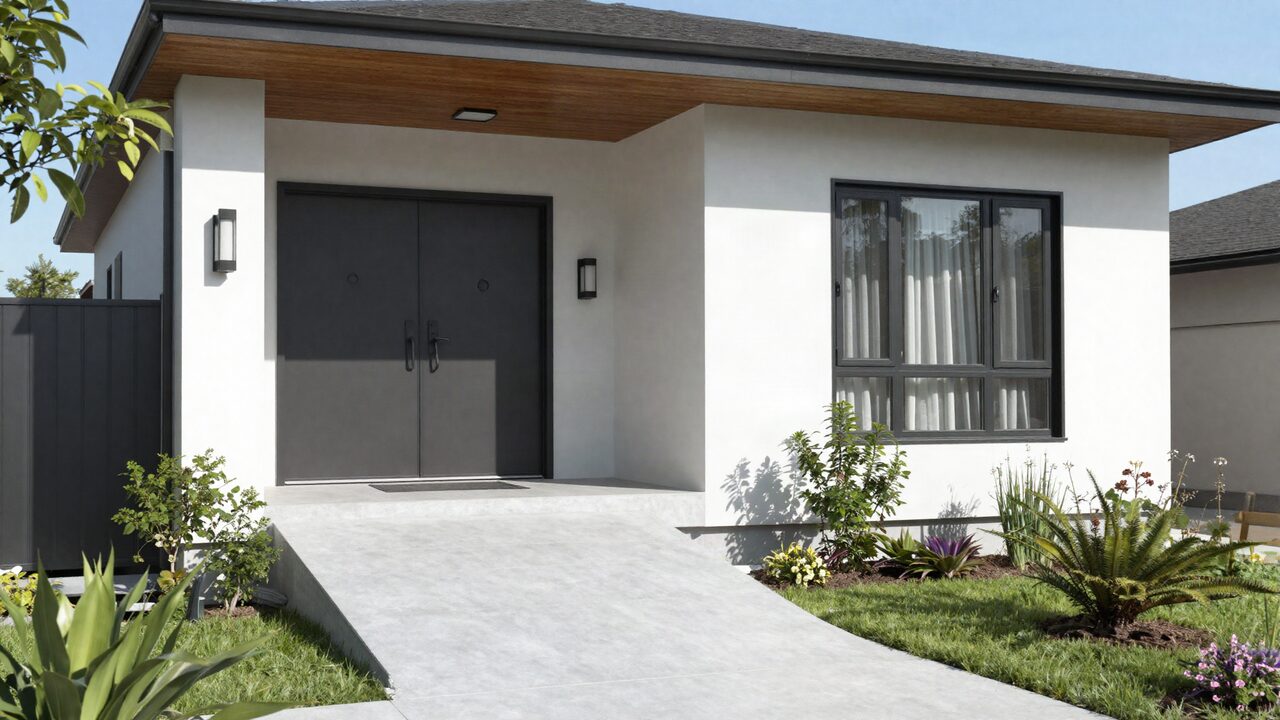
- Describe the approach. Which driveway, where to park all the cars, which door, and what the house looks like from the street.
- Light the way. Put exterior lights on a timer so a 10pm arrival isn't a search with phone flashlights.
- Have a backup. A lockbox or a person on call if the smart lock fails.
Airbnb's rebooking and refund policy lists a host failing "to provide their guest access to the accommodations" as a reservation issue, which can lead to a refund that comes out of your payout. A smooth check-in protects both your rating and your income. When guests book JekkyStay homes directly, our Check-in Promise says: "If your group can't get into the home at check-in and we can't get you in within one hour of your call, we refund your first night."
Cleanliness: the category with no partial credit
Guests notice the one thing that wasn't cleaned, not the hundred things that were.
A home can be 98% clean and still lose a star for hair in a shower drain or crumbs in a drawer. Cleanliness also carries real consequences: Airbnb's rebooking policy counts a home that is "not reasonably clean and sanitary" as a reservation issue.
What makes the difference:
- A written checklist that the crew follows room by room, so quality doesn't depend on who cleaned. Our turnover checklist for large homes covers it in order.
- Photos of each finished room, sent by the crew before they leave.
- A final walk-through that checks the places guests look first: the shower, the sheets, the fridge, the kitchen counters and the floor under the beds.
- Enough linens that nothing goes on a bed damp or stained.
- Fresh air. A home that smells clean reads as clean.
Large homes need more time than owners expect. A 16-guest house after a reunion is a different job from a two-bedroom condo, so block enough time between stays, even if that means losing a night now and then.
Communication: answer fast and say it plainly
Guests rate communication on speed and clarity, and both are habits you can build.
Airbnb's Superhost criteria include responding to 90% of new messages, which shows how much weight the platform puts on response. For a five-star stay, aim higher: answer within the hour during the day and quickly at night when something is urgent.
Good communication is also proactive. Send messages at the moments guests need them:
| When | What to send |
|---|---|
| At booking | Thanks, and anything they need to know before the trip |
| 3 to 5 days before | Check-in instructions, parking, house rules |
| Morning of arrival | A short reminder with the door code and your number |
| An hour after check-in | A check that everyone got in and has what they need |
| Day before checkout | Checkout steps, kept short |
| After checkout | Thanks, and a request for an honest review |
Keep house rules short and specific. Our guide to house rules for groups shows how to set quiet hours and occupancy rules without sounding unfriendly.
When something goes wrong during the stay
Most four-star and one-star reviews start with a problem that wasn't fixed quickly enough, not with the problem itself.
The air conditioning fails on a hot afternoon. The Wi-Fi drops during a work call. The hot tub is cold. Guests forgive these things when the response is fast, honest and visible.
- Answer right away, even if all you can say is that someone is on the way.
- Give a time and keep it. If the repair takes longer, say so before the guest has to ask.
- Offer something practical while it is broken: fans, a hotspot, a recommendation for the afternoon.
- Follow up once it is fixed.
Our Stay Promise for direct bookings puts this in writing: "If the home isn't as described, or something important stops working, such as the air conditioning or heat, hot water, Wi-Fi or the pool, tell us. If we can't fix it within 24 hours, we refund the nights affected or move your group to a similar home."
How to ask for reviews within the rules
Ask every guest for an honest review, in the same way, and never tie anything of value to a positive one.
Airbnb's reviews policy says reviews "may not be provided or withheld in exchange for something of value," and bars hosts and guests from pressuring or incentivizing each other to influence a review. The FTC's Consumer Reviews and Testimonials Rule, in effect since October 21, 2024, bars incentives that require or imply a positive review. FTC staff say a general request to all customers to post reviews is fine.
What works within the rules:
- A short thank-you message after checkout with a plain request: "If you have a minute, an honest review helps other groups decide."
- Leaving your own review of the guest promptly. Airbnb says guests and hosts have 14 days after checkout, and reviews post once both have submitted or when the 14 days end.
- Replying to every review briefly. Thank the good ones; answer the critical ones with what you changed.
What not to do: offer a discount, a refund or a future credit for five stars; ask only the guests you think were happy; or argue with a guest in a public reply. If a guest threatens a bad review to get money, see our guide on what to do when guests threaten a bad review for a refund.
Why ratings matter beyond the review page
Your rating affects your ranking, your badges and how much a guest trusts you before booking.
Airbnb's Superhost status requires a 4.8 or higher overall rating, checked every 3 months over the previous 12 months. Ratings also feed how listings appear in search. A strong record matters on direct bookings too: guests who find your home by name will look up your reviews before they pay. Our guide on getting more direct bookings covers how to turn good stays into repeat guests.
If you would rather not run messages, turnovers and repairs yourself, our owner services cover the parts that drive reviews. The Essential package on our pricing page includes 24/7 Guest Communication, Cleaning & Maintenance Coordination, Professional Photography and Smart Home Integration. Self-managing can work well for a single home near where you live; our guide to self-managing or hiring a manager covers when each makes sense.
The bottom line
Five-star reviews are not a trick. They come from a listing that tells the truth, a check-in that works at 10pm, a home cleaned to a written standard, and an owner who answers fast and fixes things during the stay. Do those on every booking, ask every guest for an honest review, and never trade anything for a good one.
Frequently asked questions
What do guests rate in an Airbnb review?
Airbnb's star ratings page lists an overall rating plus categories for cleanliness, accuracy, check-in, communication, location and value. Airbnb says the overall rating is its own category, not an average of the others.
How long do guests have to leave a review on Airbnb?
Airbnb says guests and hosts have 14 days after checkout to submit a review. Reviews post once both have submitted, or when the 14 days end, whichever comes first.
Can I offer a discount for a five-star review?
No. Airbnb's reviews policy says reviews may not be provided or withheld in exchange for something of value. The FTC's rule on consumer reviews also bars incentives that require or imply a positive review. You can ask every guest for an honest review.
What rating do I need to become an Airbnb Superhost?
Airbnb's Superhost page lists a 4.8 or higher overall rating, a 90% response rate, a cancellation rate under 1%, and at least 10 reservations or 3 reservations totaling 100 nights, checked every 3 months over the previous 12 months.
What is the most common reason for a four-star review?
Usually it is a gap between what the guest expected and what they found: a bed layout that was unclear, a step-filled entry, a slow reply or a missed spot in the cleaning. Most of these are fixed in the listing and the turnover checklist.
Should I reply to reviews?
Yes, briefly and calmly. Thank good reviews, and answer a critical one with what you fixed. Future guests read the reply as much as the review.