Quick answer
Assign bedrooms before anyone pays, in a fixed order everyone has seen: guests with a real need choose first, the best room goes to whoever pays extra for it or wins a draw, and the rest are drawn at random. Write the plan down and send it with the house link.
Most bedroom fights are not about the rooms. They come from surprise: someone arrives and finds the room they assumed was theirs already has a suitcase in it. A clear order, agreed early, removes the surprise.
Key takeaways
- Assign rooms before anyone pays a deposit, and send the plan in writing with the house link.
- Hand out rooms in a set order: needs first, then the paid upgrade for the best room, then a draw for the rest.
- Price the primary suite openly as a fixed add-on, or put it in the draw. Never just give it to the organizer.
- Group sleepers by schedule: early risers near the kitchen end, night owls and the game room together.
- Kids go in the bunk room or with cousins, with the youngest on the bottom bunk.
In this guide
- Do it before the deposits, not at the front door
- A five-step order that settles most rooms
- The primary suite: price it or draw it
- Couples, singles and the beds you actually have
- Early risers, night owls and snorers
- Kids and bunk rooms
- Run the draw so no one can call it rigged
- Write it down and handle the last-minute change
- The bottom line
Do it before the deposits, not at the front door
The time to assign rooms is when you share the house and ask for deposits, because that is when each person decides what they are paying for.
Once you have picked a home, send one message with:
- The listing link, so everyone can see the photos of each bedroom.
- A simple list of rooms and beds.
- The order in which rooms will be handed out (the next section).
- The date by which the plan is final.
If you are still deciding how big a house you need, start with our guide to how many bedrooms your group needs. This guide picks up once the house is chosen and the question is who sleeps where.
A five-step order that settles most rooms
Hand out rooms in a set order, and publish that order before anyone chooses.
| Step | Who goes | Why |
|---|---|---|
| 1. Needs | Anyone with a medical, mobility or baby need | A need beats a preference, and almost no one argues with it |
| 2. Paid upgrade | Whoever takes the best room at an agreed extra price | Turns the fight over the best room into a price |
| 3. Kids | Children placed together, near a parent | Kids care about cousins more than about the room |
| 4. Couples and pairs | Rooms with one bed to couples, two-bed rooms to pairs | Matches beds to people before anyone picks |
| 5. The draw | Everyone left picks in random order | Nobody can say the organizer took care of their friends |
Needs cover a guest who uses a CPAP machine and wants a quiet room, someone who can't manage stairs, a parent with an infant, or a guest recovering from surgery. Ask in the first message: "Does anyone need a particular kind of room?" Then honor what comes back.
Kids come before the draw because placing them shapes everything else. If the cousins share a bunk room, their parents can take the rooms nearby.
Couples and pairs come next because beds matter more than rooms. A couple needs one bed. Two friends, or a parent and an older child, need two sleeping surfaces.
The primary suite: price it or draw it
The best room in the house should either cost more or go to chance; giving it away quietly is what starts the arguments.
Two clean options:
- A fixed add-on. Set a flat amount for the primary suite and announce it up front. Whoever wants it pays that amount on top of their share, and it comes off everyone else's. If two households want it, flip a coin or split the nights.
- Put it in the draw. No extra cost. The household that draws first gets first choice, and the primary suite is just one of the options.
The one approach that reliably causes trouble is the organizer taking the best room "because I did all the planning." Some groups are happy to reward the organizer that way, but ask the group out loud first. Our guide to splitting costs on a group vacation rental covers how to weight room prices if you'd rather build the difference into everyone's share.
Couples, singles and the beds you actually have
Read the bed list, not the bedroom count, before you match people to rooms.
Real homes show why. Across our six homes, the layouts are quite different:
- In the Sacramento home, Bedroom 1 has a king bed and Bedroom 2 has a queen with a private en-suite bathroom. Bedrooms 3 and 4 each have a queen plus a sofa bed, and Bedrooms 6 and 7 each have a double bed.
- In the Roseville home, every one of the five bedrooms has a queen bed and a sofa bed, and the primary suite adds a private deck. Every room can take a couple plus one more.
- In the Houston home, four bedrooms have one queen each and the fifth has two queens, and the primary bedroom has a sofa bed as well.
- In the Antioch home, each bedroom has a twin bed (one has two twins) plus a full-size air mattress, a seventh air mattress is in the shared living room, and two full bathrooms are shared.
- In the Kissimmee home, there is one king bedroom, four queen bedrooms and an upstairs bunk room with four beds in two bunk beds.
A room with one queen bed suits a couple. A room with a queen and a sofa bed suits a couple with a child, or two friends who don't mind one taking the sofa bed. Two singles should not be asked to share one bed unless they offered.
Singles often end up with whatever is left. Fix that in the order: once couples are matched to one-bed rooms, the two-bed rooms and rooms with a sofa bed go to singles before the draw opens, so no single adult lands on an air mattress in the living room by default.
Shared sleeping areas in a living room or media room should go to volunteers, ideally younger adults who will be up latest anyway. If nobody volunteers, rotate it night by night.
Early risers, night owls and snorers
Group people by when they sleep, not only by who they are related to.
Most houses have a loud end and a quiet end. The loud end is near the game room, the movie room or the kitchen where people stay up talking. Put night owls there. Put early risers near the kitchen if the kitchen is quiet in the morning, so they can make coffee without walking past every bedroom.
The Sleep Foundation notes that "noises at night might wake you up, and a fragmented night's sleep is less refreshing," and that "ear plugs are an effective tool as long as they don't interfere with your ability to sleep." Put a pack of foam earplugs in the shared supplies list. It costs a few dollars and settles a lot.
Snoring is the one topic people avoid, and it causes the most swaps at 2am. Ask in the first message: "Anyone snore, or need quiet to sleep?" Put known snorers in rooms that share no wall with a light sleeper. The Sleep Foundation also says very loud snoring with choking or gasping sounds can be a sign of sleep apnea, which is worth a quiet word with a relative afterward.
Kids and bunk rooms
Kids sleep best together and near a parent, and the youngest go on the bottom bunk.
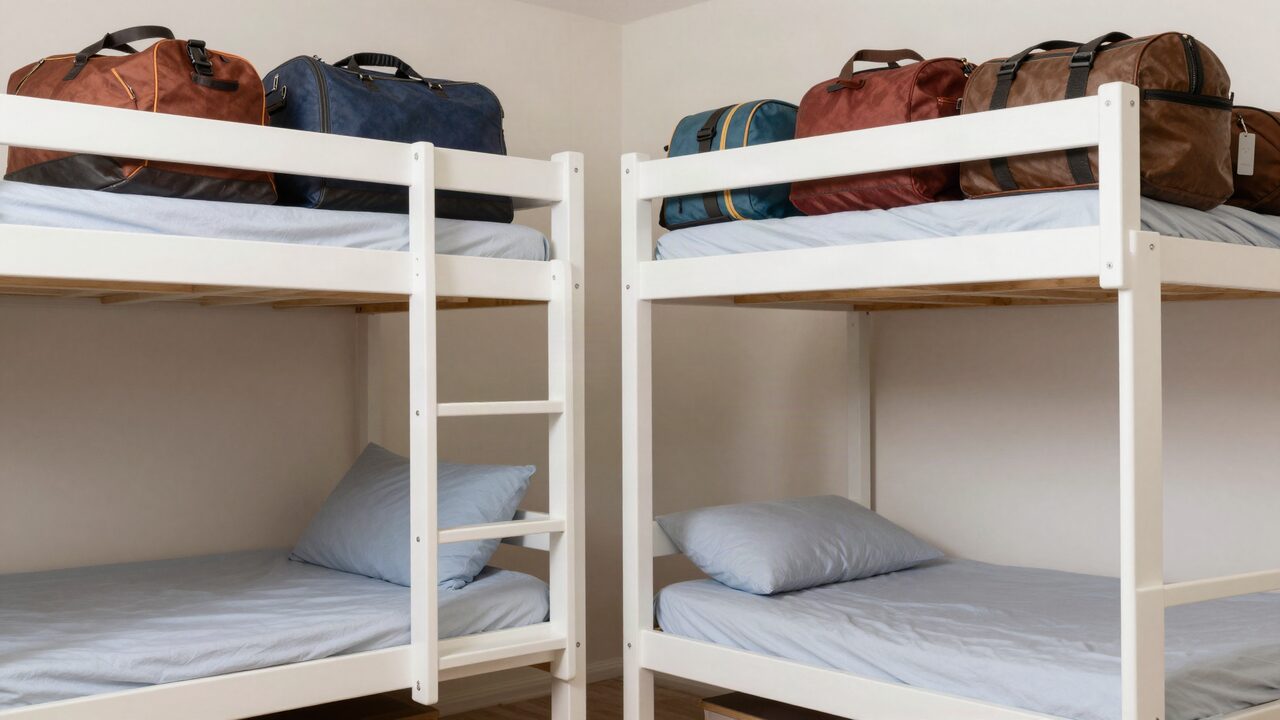
A bunk room is often the most popular room in the house with children. Fill it with cousins of similar ages, and put a parent in the next room. Teenagers usually prefer their own space; a room with two beds works better for two teens than a bunk room full of eight-year-olds.
Bunk safety is simple. U.S. federal rules require bunk beds to have "at least two upper bunk guardrails, with at least one rail on each side," and the tops of the guardrails must be "no less than 5 inches above the top of the mattress," according to the U.S. Consumer Product Safety Commission. Bunk beds also carry a required warning label. Keep children under 6 on a lower bunk, and leave the guardrails in place.
Run the draw so no one can call it rigged
A draw is only fair if everyone can see how it was done.
- List the rooms left after needs, the paid upgrade, kids and pairs have been placed.
- Draw by household, not by person, so a family of four doesn't get four tickets.
- Do it in the open: on a video call, in the group chat with a screen recording of an online random picker, or with names in a hat at a family dinner.
- Pick in draw order, one household at a time, with a short time limit for each pick.
- Post the final plan in the group chat right away.
For a trip you take every year, reverse the order the next year, so last year's last picker chooses first.
Write it down and handle the last-minute change
Send the final plan as one short list, and treat it as settled unless two people agree to swap.
A simple format works:
| Room | Beds | Who | Notes |
|---|---|---|---|
| Room with private bath | Queen | Couple A | Paid upgrade |
| Two-bed room | Two doubles | Two friends | |
| Bunk room | Four bunks | Four cousins | Under-6s on the bottom |
| Living room sofa bed | Sofa bed | Volunteer | Rotates nightly |
When someone drops out, their room goes to the next household in draw order, not to whoever messages first. When someone joins late, they take what is left, unless someone offers to swap.
On arrival, put a sticky note on each door with the names. It saves the hallway confusion when twelve people arrive with luggage at once.
If you are still choosing a home, browse homes for groups, each listed with its bedrooms and beds, or see our pages for family reunions and group getaways. For trips with grandparents and toddlers, our guide to multigenerational family trips has more on rooms by age.
The bottom line
Decide the rooms before deposits, in a published order: needs first, a priced upgrade or a draw for the best room, kids placed together, beds matched to couples and singles, and a visible random draw for the rest. Group sleepers by schedule, put the youngest on the bottom bunk, and send the plan in writing. A clear order turns the fight over rooms into a two-minute message.
Frequently asked questions
Who should get the best bedroom on a group trip?
Whoever needs it most, or whoever pays for it. A guest with a medical need or a baby gets first call. If no one has a need, offer the best room as a paid upgrade or put it in a random draw. Don't hand it to the organizer by default.
Should couples always get the bedrooms with one bed?
Usually, since a couple needs one bed and singles need separate beds. A room with one queen bed suits a couple; a room with two beds, or a bed plus a sofa bed, suits two friends or a parent and child.
How do we run a fair bedroom draw?
Settle the rooms that go by need first, then draw names for the rest in a video call or with an online random picker, and let people choose in draw order. Publish the order before anyone picks so no one feels it was rigged.
Where should kids sleep on a group trip?
Together, in a bunk room or a room with several beds, close to at least one parent. Put children under 6 on a lower bunk, never the top.
What if someone is unhappy with their room?
Offer a swap with anyone willing, or a small credit off their share. If the plan was agreed in writing before booking, most complaints end there.
When should we assign bedrooms?
Before deposits are paid, so each person knows what they are paying for. Waiting until arrival turns the hallway into a negotiation.