Quick answer
Airbnb and Vrbo both ban security cameras and recording devices inside a vacation rental, and both allow outdoor cameras that are disclosed in the listing and kept away from private spaces such as outdoor showers. Vrbo adds stricter outdoor rules, and state recording laws make audio the riskiest feature on any camera.
This is general information, not legal advice. Platform policies change, so we quote each one as it read when we checked it on November 28, 2026. Talk to a local attorney before you install or change devices.
Key takeaways
- Airbnb and Vrbo both ban cameras and recording devices that monitor any part of a rental's interior, even when switched off on Airbnb, and both ban hidden devices.
- Outdoor cameras are allowed on both platforms if they are disclosed in the listing and kept away from places such as outdoor showers and saunas.
- Vrbo's policy is stricter outdoors: cameras must monitor access points, disclosure must cover location and coverage, and a camera that can see a pool or hot tub must be disclosed in the listing and at the property.
- Noise monitors that measure sound levels without recording audio are allowed on both platforms if disclosed, but never in bedrooms, bathrooms or sleeping areas on Airbnb.
- Audio is the legal trap: 11 states, including California and Florida, primarily require every party's consent to record a conversation, so turn audio off on outdoor cameras.
In this guide
The short answer
Indoors, the answer is no on both major platforms. Outdoors, the answer is yes with conditions, and the conditions are where owners get caught out.
| Airbnb | Vrbo (Expedia Group policy) | |
|---|---|---|
| Indoor cameras | Banned, even when off or disconnected | Banned, including cameras pointed in from outside |
| Hidden cameras | Always prohibited | Never allowed |
| Outdoor cameras | Allowed; location disclosed in the listing description | Allowed if they monitor access points; location and coverage clearly disclosed |
| Pool or hot tub in view | Not addressed separately | Must be disclosed in the listing and at the property |
| Private outdoor spaces | No cameras in enclosed outdoor showers or saunas | No devices anywhere guests expect privacy, such as near an outdoor shower or sauna |
| Noise monitors | Allowed if disclosed; not in bedrooms, bathrooms or sleeping areas | Allowed if disclosed before booking and they do not record or transmit audio |
| Smart home devices | Allowed; disclosure encouraged, not required | Allowed if disclosed and guests can turn them off |
| Effective date stated | April 30, 2024 | No date shown on the page |
The rest of this guide goes through each rule, what it means for a real property, and the state laws that sit on top of both platforms.
Airbnb's rules, quoted
Airbnb bans every camera that watches the inside of a home. Its help article, titled "Restrictions on security cameras and other devices in homes," says: "Hosts are not allowed to have security cameras and recording devices that monitor any part of a home's interior." It adds that this applies even when devices are "turned off or disconnected," and lists the hallway, bedroom, bathroom, living room and guest house as examples of interior spaces.
On hidden devices, Airbnb is blunt: "Hidden cameras have always been prohibited and will continue to be prohibited."
Exterior cameras are allowed. The article says: "Hosts are allowed to have exterior security cameras and recording devices," and that hosts "are required to make sure their location is disclosed in the listing's description." They may not be placed over exterior areas where guests have a greater expectation of privacy, such as "the inside of an enclosed outdoor shower or in a sauna."
Noise decibel monitors are treated separately. Airbnb defines them as devices that "assess sound levels and their duration but do not record audio." Hosts may have them as long as they disclose their presence, they may not be in "bedrooms, bathrooms, or sleeping areas," and "Hosts are not required to disclose where their noise decibel monitors are located."
Smart home devices, such as smart speakers, are allowed, and disclosure is "encouraged, but not required." The page notes one exception to the indoor ban: certain licensed homes in Japan may need an entryway camera, which must be disclosed and is prohibited from recording audio.
The date matters if you have run a rental for a while: "These rules took effect on April 30, 2024." A listing set up before that date may still describe an old camera in its house rules or listing text, which is worth checking even if the camera is long gone.
Vrbo's rules, quoted
Vrbo's policy is stricter than Airbnb's outdoors and adds rules for pools, hot tubs and stored footage. The policy sits on Expedia Group's marketplace policy pages and says: "This policy applies to any Vrbo vacation rental booked on any Expedia Group brand."
Indoors, the rule matches Airbnb's in substance: "Surveillance devices, such as cameras and audio recorders, are not allowed inside of a vacation rental." Devices "must never be used to monitor the inside of a vacation rental, including by pointing in from outside," and "Hidden or disguised surveillance devices are never allowed." The one indoor allowance is for multi-unit buildings, where "indoor cameras may be used in the common spaces of the building" for security and safety.
Outdoors, owners may use security cameras only if all of these are true:
- The cameras monitor the property's access points.
- Their location and coverage are clearly disclosed in the listing. The policy adds: "Showing the camera in a photo of the property is not enough."
- If a camera can see a pool or hot tub, "hosts must disclose this" in the listing and at the property.
- Hosts "must take reasonable measures to limit what information is collected and stored and who has access to recordings," and "Stored recordings should be deleted when they are no longer needed, in compliance with applicable laws."
Smart devices "may be used if they are disclosed in the listing" before booking and "there is an option for guests to turn them off." Noise monitors may be used if they are disclosed before booking and "do not record or transmit any audio."
The policy also spells out what happens after a complaint: "If a guest finds a surveillance device that appears to violate this policy, they should contact us immediately," and "Guests may be eligible for a refund if their stay is affected by a host's violation of this policy." On the host side, Vrbo says it will investigate and take action that may include "suspension or termination," that canceled future bookings may bring "additional enforcement under the Host Cancellations Policy," and that hosts "may be required to refund guests whose reservations are affected."
What this means for a real property
The lowest-risk setup is a small number of exterior cameras aimed at entry points, with audio off, described plainly in the listing. Here is how that plays out at a typical group home.
Front door and driveway. A video doorbell or a camera over the garage covering the driveway is the most common setup, and it fits both platforms. It tells you when guests arrive, how many cars there are and whether a party is forming. Describe it in the listing text, not just in a photo.
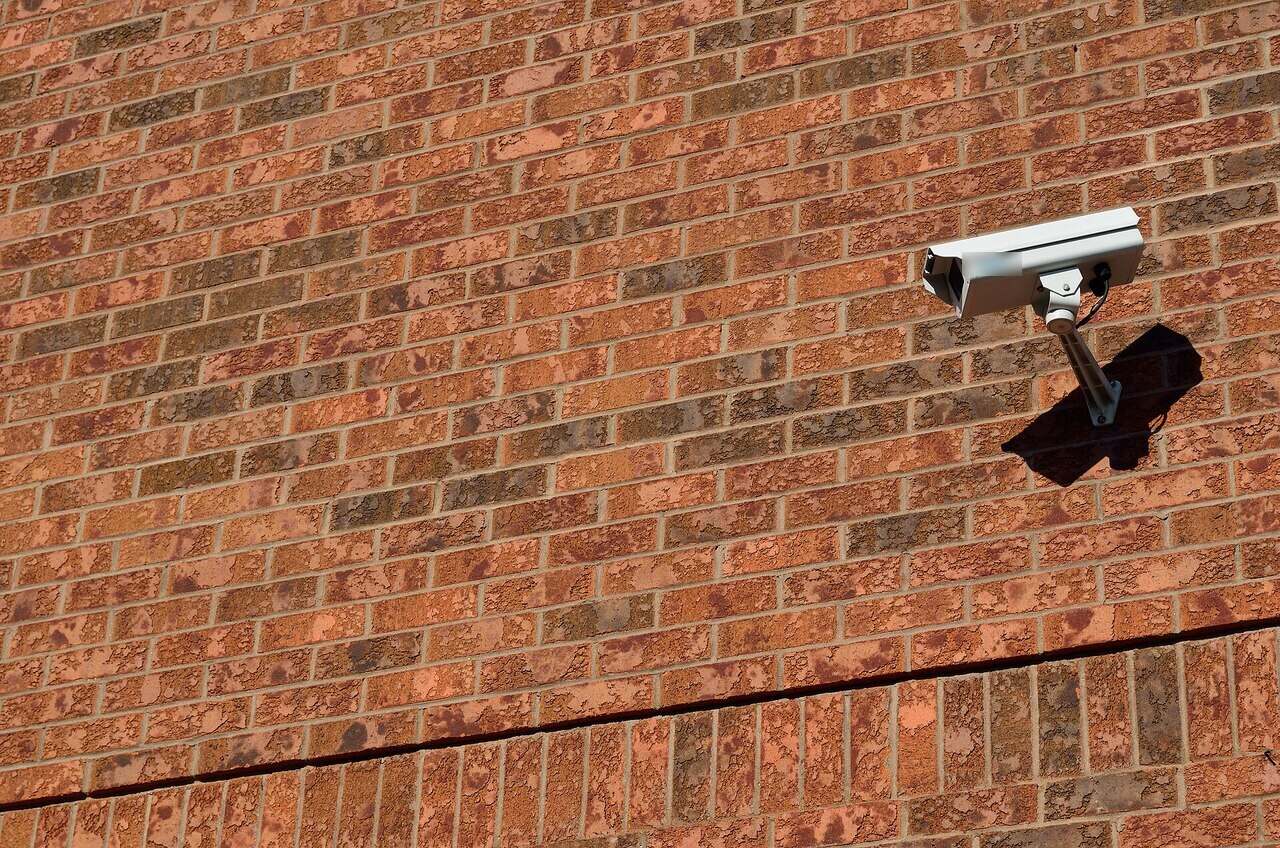
Windows in the frame. This is an easy mistake to make. A camera aimed at the front door may also see through a sidelight window into the entry hall, or across a glass slider into the living room. Both platforms ban monitoring the interior, and Vrbo bans it explicitly "including by pointing in from outside." Check each camera's live view at night with the lights on inside, because that is when windows show the most.
Backyard, pool and hot tub. A camera that sees the pool is allowed on Vrbo only with disclosure in the listing and at the property, and many guests find it uncomfortable even when disclosed. If you want pool safety coverage, consider a gate alarm instead, or aim the camera at the gate rather than the water.
Outdoor showers, saunas and hot tub enclosures. Keep every camera away from them. Both platforms name these spaces.
Garages and storage rooms. If the garage is part of the guest space, it is interior. If it is a locked owner area guests never enter, ask the platform how it treats a camera there before you install one, and document the answer.
State recording laws and audio
Platform rules are only half the picture: state and federal laws apply to every camera, whatever the platform allows. The part that catches owners is audio.
Federal law sets a one-party consent rule. Under 18 U.S. Code 2511(2)(d), it is not unlawful for a person to intercept a communication "where such person is a party to the communication or where one of the parties to the communication has given prior consent." An owner whose doorbell records two guests talking on the porch is not a party to that conversation, so even the federal minimum is not met.
Many states go further. The Reporters Committee for Freedom of the Press lists 11 states that primarily require the consent of all parties: California, Delaware, Florida, Illinois, Maryland, Massachusetts, Michigan, Montana, New Hampshire, Pennsylvania and Washington. It notes that Missouri and Oregon have all-party rules for in-person conversations, Connecticut and Nevada for phone calls, and that Hawaii and Maine require all-party consent only in particularly private places.
For owners in our markets, that means California and Florida homes sit in all-party consent states. Texas and Virginia do not appear on the Reporters Committee's all-party list, but the federal rule above still applies.
Video has its own laws. The Reporters Committee says: "Each state and the District of Columbia has laws outlawing certain uses of hidden cameras in private places, although many laws are specifically limited to attempts to record nudity." It also notes that a person's home "has special significance" for privacy, and that secret recording in a private place may support an invasion-of-privacy lawsuit depending on the state. A rented home is the guest's private space for the length of the stay.
| Feature | Platform risk | Legal risk |
|---|---|---|
| Exterior video, disclosed, aimed at entries | Low if disclosure matches | Low in most places |
| Exterior video that can see inside | Breaks both platforms' rules | Can be serious under state privacy laws |
| Audio on an exterior camera | Allowed by Airbnb if disclosed; Vrbo treats audio recorders as surveillance devices | High in all-party consent states |
| Any hidden or disguised device | Banned on both | High everywhere |
| Noise monitor, no audio recorded | Low if disclosed | Low |
Some cities and counties also regulate short-term rental cameras through their permit rules. Read your local ordinance, or see our guide to short-term rental permits, and ask your attorney whether anything local applies. This is general information, not legal advice.
Disclosure that holds up
Good disclosure is specific, in writing, and visible before the guest books. Vague lines like "exterior cameras on property" meet the letter of some rules and invite disputes.
A disclosure that works on both platforms names each device, where it is and what it covers:
- "Video doorbell at the front door. Covers the front porch and walkway. No audio recording."
- "Camera above the garage. Covers the driveway and street parking in front of the home. No audio recording."
- "Noise monitor in the living room. Measures sound levels only; it does not record audio."
Put the same list in the listing description, the house rules and the house manual, and keep it current. If you add, move or remove a device, update all three the same day. Mismatched disclosures make it harder to defend yourself if a guest complains.
On your direct booking site, use the same wording. Guests who book directly expect the same privacy as on a platform, and the state laws above apply either way. If you list on several channels, see our comparison of Airbnb and Vrbo for large homes for other ways their rules differ.
The downsides and the honest tradeoffs
Cameras help with parties, occupancy limits and damage claims, but they come with costs owners rarely count.
Guest trust. Some guests may skip a listing that mentions cameras, even exterior ones. A clear, short disclosure is easier to trust than a vague one.
Complaints and refunds. A guest who finds an undisclosed device can ask for a refund, and Vrbo's policy says hosts may be required to pay it. A camera that saved you one damage claim can cost you a week's booking if the disclosure was wrong.
Data you now hold. Footage of guests is personal data. Vrbo's policy asks hosts to limit who can see recordings and delete them when no longer needed. Shared logins with a cleaner or a relative are an easy way to lose control of it.
Maintenance. Cameras go offline, batteries die and apps change settings after updates, sometimes turning audio back on. Someone has to check them between stays.
Where cameras don't help. A camera won't stop a party once it starts. Pairing a disclosed noise monitor with clear house rules, a booking agreement and fast response tends to do more. Some owners decide the risk and admin aren't worth it and rely on a doorbell, a noise monitor and good screening.
When professional management helps
Most of the work here is ongoing: auditing camera views, keeping disclosures consistent across channels, responding to alerts and handling the guest when something goes wrong. For an owner with one home and time to do it, self-managing camera policy is reasonable.
If you run several channels or live far from the property, that upkeep is part of what a manager does. JekkyStay's management packages include Smart Home Integration and 24/7 Guest Communication; see what each includes on our pricing page, or read more about how we work with owners. For a home-specific recommendation, get a quote.
The bottom line
Airbnb and Vrbo both ban indoor cameras and hidden devices, and both allow disclosed outdoor cameras that stay away from showers, saunas and windows. Vrbo goes further, requiring cameras to cover access points, disclosure of location and coverage, and notice when a pool or hot tub is in view. On top of that, state laws make audio the biggest legal risk, especially in all-party consent states such as California and Florida. Keep cameras outside, aim them at entries, turn audio off, disclose each device in writing everywhere you list, and check the policy pages and your local rules before you change anything. This is general information, not legal advice; ask an attorney about your property.
Frequently asked questions
Can I have indoor security cameras in my Airbnb?
No. Since April 30, 2024, Airbnb's policy says hosts are not allowed to have security cameras and recording devices that monitor any part of a home's interior, and that this applies even when the devices are turned off or disconnected. Airbnb lists a narrow exception for certain licensed homes in Japan.
Does Vrbo allow indoor cameras?
No. The surveillance devices policy that applies to Vrbo rentals says cameras and audio recorders are not allowed inside a vacation rental, and devices may not be pointed in from outside. Indoor cameras may be used only in the common spaces of a multi-unit building.
Do I have to disclose outdoor cameras on my listing?
Yes, on both platforms. Airbnb requires the location of exterior cameras in the listing description. Vrbo requires the location and coverage to be clearly disclosed in the listing, and says showing the camera in a photo is not enough.
Can I use a video doorbell at a vacation rental?
Generally yes, as an exterior camera, if it is disclosed as the platform requires and does not see inside the home. Check whether it records audio: in all-party consent states such as California and Florida, recording guests' conversations without consent can break state law. This is general information, not legal advice.
Are noise monitors allowed in vacation rentals?
Yes, if they measure sound levels without recording audio and you disclose them. Airbnb does not allow them in bedrooms, bathrooms or sleeping areas and does not require you to disclose their exact location. Vrbo requires disclosure before booking and that the device does not record or transmit audio.
What happens if a host breaks the camera rules?
The policy that covers Vrbo says it will investigate and may suspend or terminate the host, cancel future bookings and require refunds to affected guests. Airbnb's camera page did not list consequences when we checked, but breaking a platform policy can put a listing at risk.