Quick answer
The way to keep kids busy at a big group vacation rental is to plan the structure, not every minute: a shared kit of rainy-day activities, a kids' table with its own routine, adults taking turns on duty, screen rules everyone agrees on in advance, and outdoor games that fit each age. Then leave plenty of time for the kids to just play.
Key takeaways
- Pack one shared rainy-day kit per family and pool it on arrival, so the house has a full supply of crafts, puzzles and games from the first hour.
- Give the kids their own table, their own meal times when it helps, and a job at every meal.
- Rotate adult supervision in short shifts with a named adult on duty, so every parent gets real time off.
- Agree on screen rules as a group before the trip, so no family has to be the strict one.
- Near any water, one adult watches the children and does nothing else, and that duty passes by hand-off, never by assumption.
In this guide
Start with a shared rainy-day kit
The single most useful thing a group can bring is one combined box of things to do, assembled before anyone leaves home.
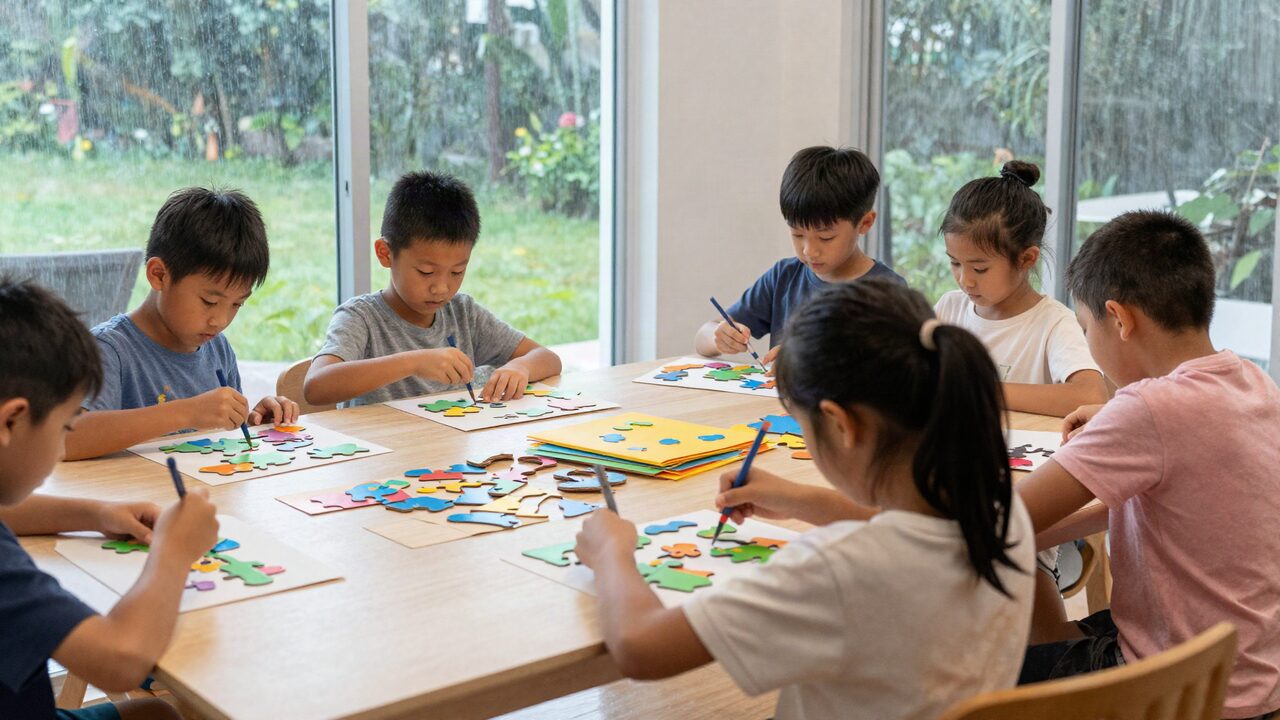
Ask each family to pack one bin with a short list of items, then pool everything on the first afternoon. A group of four families ends up with four times the variety, and nobody has to carry a car full of toys. Put the combined kit somewhere visible, such as a corner of the living room or a shelf near the dining table, so kids can help themselves.
| Item | Why it works | Best ages |
|---|---|---|
| A 300 to 1,000 piece jigsaw puzzle | Runs all week on a side table; adults join in | 7 and up |
| Two or three card games | Quick, small, easy to teach across ages | 5 and up |
| One mixed-age board game | Gets older and younger kids at one table | 6 and up |
| Paper, markers, tape, stickers | Endless, cheap, no rules needed | All ages |
| A complete craft project | Fills a rainy morning; something to take home | 4 and up |
| Charades or drawing prompts on slips | Works for a crowd after dinner | 6 and up |
| Picture books and chapter books | Quiet time and bedtime | All ages |
| Sidewalk chalk and a ball | Ready the moment the rain stops | All ages |
Leave out anything that makes a mess you can't clean, such as glitter, slime or permanent paint. A rental is someone's home, and stains on a rug or a table can end up as a damage charge.
Give the kids their own table and their own jobs
A kids' table plan solves most of the friction at group meals, and it makes the kids feel the trip is theirs too.
Set the kids up at their own table, or one end of the main table, with a simple routine: they sit together, they help set and clear, and they have one adult nearby for refills and spills. Younger children often eat earlier than the adults, so many big groups run two sittings at dinner: kids at 5:30, adults at 7. The adults eat in peace and the kids get to bed on time.
Give every child a job. A rotating chart on the fridge works well:
- Table setters lay out plates, cups and napkins.
- Water crew fills cups and brings the pitcher.
- Clearers carry plates to the counter.
- Menu writers write the night's dinner on paper for the table.
- Taste testers help stir, wash vegetables or decorate dessert.
Kids who have a job behave better at the table and get bored less, and it takes real work off the adults. Our group meal plan for a vacation rental has more on cooking for a crowd.
Rotate adult supervision in shifts
Taking turns on kid duty is what lets every parent actually rest on a group trip.
Without a plan, the same two or three adults end up watching everyone's children all week. With a plan, each adult knows when they are on and when they are off. Split the day into blocks of two or three hours and put names on a simple chart.
| Block | On duty | What it covers |
|---|---|---|
| 7 to 9am | Two early risers | Breakfast, quiet games, letting late sleepers rest |
| 9am to noon | One adult per family, taking turns | Outings, outdoor play |
| Noon to 2pm | One adult | Lunch and quiet time |
| 2 to 5pm | Two adults | Pool, yard or an outing |
| 5 to 7pm | Cooks are off duty; others on | Kids' dinner and baths |
| 7pm on | Parents of the youngest | Bedtimes, then free |
A few rules make the chart work:
- Name the person. "Someone will watch them" means nobody does. Write a name in every block.
- Hand off out loud. When a shift ends, the next adult says "I've got them" before the first one walks away.
- Match the duty to the kids. Toddlers need an adult within arm's reach; older kids need an adult who knows where they are.
- Give every adult time off. A free afternoon is often the best part of the trip for parents of young children.
Grandparents often love a shift, especially a quiet one such as story time or a puzzle, but don't assume. Ask, and keep the more active blocks for younger adults. Our guide to multigenerational family trip planning covers pacing a trip for three generations.
Pools, hot tubs and water: adults watch
Any time kids are near water, one adult's only job is to watch them.
This is the one area of the trip with no shortcuts. The CDC advises a responsible adult who supervises closely and constantly when children are in or near water, without distractions such as phones, reading or alcohol. Pool Safely, the federal pool safety campaign, recommends naming a Water Watcher whose only job is watching children in the water.
A few habits help a big group:
- Swimmers and non-swimmers are different. Weaker swimmers stay within reach of an adult. The CDC says children should wear life jackets in and around natural water, and that foam or air-filled toys are not safety devices.
- Keep doors and gates closed. Make a house rule that no child goes outside to the pool area without telling an adult.
- Keep kids away from drains in pools and spas, as Pool Safely advises.
- Know CPR. If no one in the group has trained, a course before the trip is worth the time.
Read the home's house rules about the pool or hot tub before you arrive, and follow them. If something about the pool area isn't working the way it should, tell the host right away.
Agree on screen rules before you go
Shared screen rules, settled in the group chat before the trip, stop most arguments between cousins and between parents.
Families use different rules at home, and on a trip the strictest family often ends up feeling like the bad guy. The American Academy of Pediatrics encourages families to make a media plan around each child's needs and to follow it together. On a group trip, borrow the idea: make one simple plan for the house.
Rules that work for most groups:
- No screens at meals, for kids or adults.
- Screens at set times, such as an hour after lunch while the little ones nap, or a movie night.
- Devices sleep in the living room. Chargers go on one table, and phones and tablets stay there overnight.
- Shared screens beat solo screens. A family movie or a video game tournament on the TV brings kids together; ten separate tablets split them up.
- Older kids can earn extra time by running a game or a craft for the younger ones.
A movie night with popcorn and pillows on the floor is one of the easiest wins of any group trip. Pick the film by vote, with the youngest picking first on the first night.
Outdoor games by age
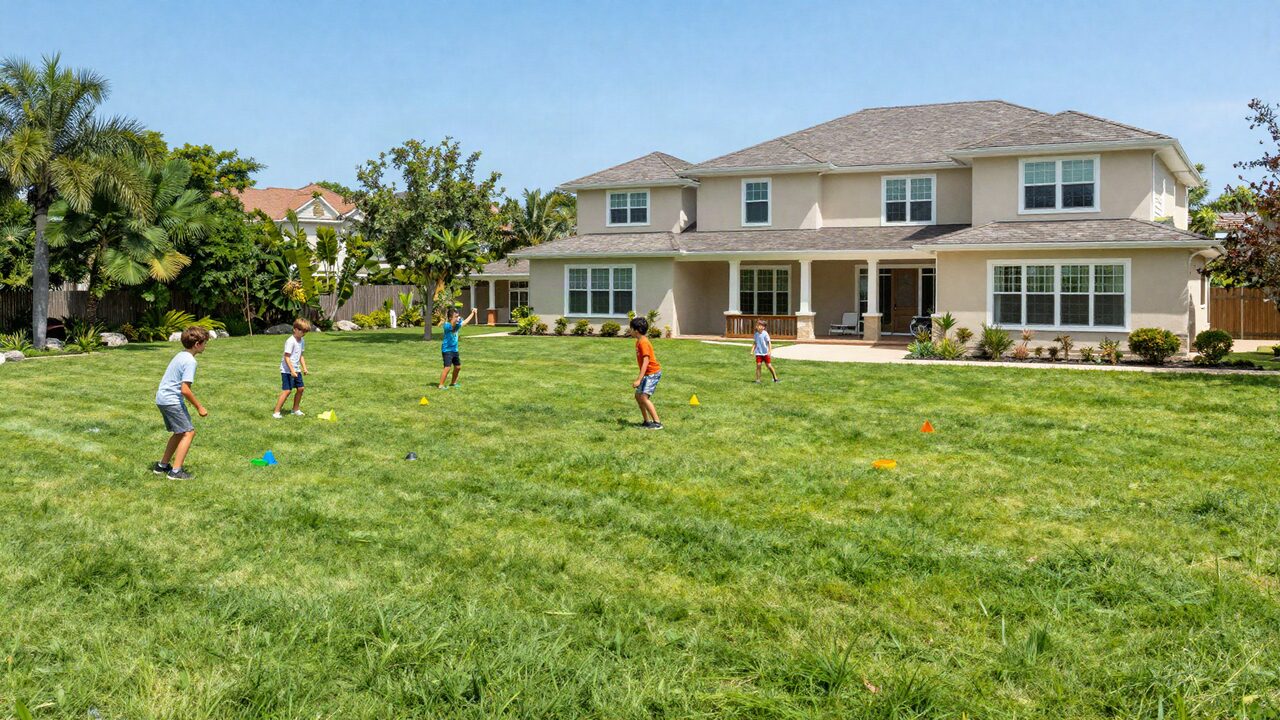
The best outdoor plan is a short list of games matched to ages, with older kids helping run games for the little ones.
| Ages | Games that work | Gear |
|---|---|---|
| 2 to 4 | Bubbles, chalk drawing, follow the leader, a short nature walk to collect leaves or rocks | Bubbles, chalk, a small bag |
| 5 to 7 | Freeze tag, red light green light, a picture scavenger hunt, beanbag toss | A list with drawings, beanbags |
| 8 to 11 | Kickball, relay races, capture the flag, a word scavenger hunt | A ball, two flags or bandanas |
| 12 and up | Frisbee, a lawn game tournament, running a game for the younger kids | A disc, lawn game set |
| All ages together | Hide and seek with boundaries, a family relay with handicaps, a sunset walk | Nothing at all |
Set clear boundaries on the first day: the edge of the yard, the end of the driveway, and the places no child goes without an adult, such as the street, the pool area and any dock or shoreline. Walk the boundaries with the kids so they can see them.
Pack outdoor games that don't need the home to provide anything: a ball, a disc, beanbags and chalk fit in one bag. Respect the neighbors too. Keep games away from the property line and bring everyone inside by the home's quiet hours.
Plan one outing a day and leave the rest open
One outing a day, with free time around it, keeps kids busy without wearing anyone out.
Kids on a group trip often care more about their cousins than about the sights. A morning at a park, a museum or a lake, followed by an afternoon at the house, works better than a packed schedule. Split the group when ages differ a lot: the older kids go on the longer hike while the little ones nap at the house with an adult on duty.
For more on planning a trip around cousins, school calendars and rooms by bedtime, read our guide to a winter break trip with cousins. For a full planning list, see our family reunions page, and browse our homes for groups in six destinations.
The bottom line
Keeping a crowd of kids busy at a vacation rental comes down to a little structure set up early: a pooled rainy-day kit, a kids' table with jobs, named adults on duty in short shifts, shared screen rules and a few outdoor games matched to ages. Around any water, one adult watches and does nothing else. Get those in place on the first day, then let the kids play.
Frequently asked questions
How do you keep kids entertained at a vacation rental?
Bring a shared kit of crafts, puzzles, cards and outdoor games, set up a kids' area on the first day, plan one or two outings, and leave open time for unstructured play. Rotating which adult is on duty keeps the plan running without wearing out the parents.
What should go in a rainy-day kit for a group trip?
A jigsaw puzzle, two or three card games, a board game that works for mixed ages, paper, markers, tape, stickers, a craft project with all its parts, a deck of charades prompts and a few books. Pack it in one bin per family and combine them at the house.
How should a big group handle kids' screen time on vacation?
Agree on simple shared rules before the trip, such as no screens at meals, screens only during set quiet times, and devices charged in a common room at night. Shared rules stop arguments between cousins whose families use different rules at home.
How many adults should watch the kids at a group vacation rental?
At least one named adult on duty at all times, with more for toddlers and for any time near water. Around a pool, lake or hot tub, the person watching should have no other job: no phone, no cooking and no conversation that pulls their eyes away.
What outdoor games work for a mixed-age group of kids?
Tag games, a scavenger hunt with picture clues for younger kids, beanbag toss, kickball, a relay race with age handicaps, and sidewalk chalk. Let older kids run a game for the little ones, which keeps both groups busy.
Can kids sleep in the same room at a vacation rental?
Often yes, and many kids love it. Put the early sleepers together and away from the living room, and give older kids a separate room so bedtimes don't collide. Check the home's maximum occupancy and bed layout before you plan rooms.