
Quick answer
A winter break trip with cousins works when you plan it around the school calendars first, then the house, then the routines. Book the nights every family's district has off, rent one home with a private bedroom per family, set two kid bedtimes, do one shared grocery run, and write down who pays for what before anyone sends a deposit.
Key takeaways
- Start with every family's school calendar: districts rarely share the same winter break, so the overlap sets your dates.
- Give each family its own bedroom or wing, and put the families with the youngest children closest to their kids.
- Agree on two bedtimes, one for little kids and one for older kids, plus a quiet hour for the adults after that.
- One shared grocery run on arrival day, paid from a kitty, beats four families shopping separately.
- Write down who covers what before anyone pays a deposit: rental, food, outings and the extras.
In this guide
- Line up the school calendars first
- Decide whether the trip touches Christmas or New Year
- Choose a house that fits three or four families
- Assign rooms by bedtime, not by family
- Set a few house rules for kids and adults
- Plan the shared grocery run
- Agree on who covers what
- Pets, gear and the first night
- The bottom line
Line up the school calendars first
The dates are set by the shortest winter break in the group, so check every district's official calendar before you look at a single house.
School districts set their own calendars, and two families twenty miles apart can have breaks that start or end days apart. Some districts close for two full weeks; others give a little less, or return on a Monday when a neighboring district returns on a Wednesday. Private schools and colleges add more variation, and a parent who works in a school may have different days again.
Do this in the first conversation:
- Each family looks up its district's academic calendar on the district's own website. Most districts post it on a calendar page; Houston ISD, for example, links its 2026-2027 academic calendar from its district calendar page, and Sacramento City Unified lists its academic calendars on its calendars page.
- Each family lists its first day off and its first day back.
- Add any work limits: a parent who can't take the week before Christmas, a shift that starts on the 2nd.
- Find the overlap, and treat it as the core trip.
If the overlap is short, you have options. One family can arrive a night early and set up the house. Another can stay a night after the others leave. Whoever adds nights pays for them, which keeps the core split simple.
| Family | Break starts | Back to school | Can arrive | Must leave |
|---|---|---|---|---|
| Family A | Dec 19 (Example) | Jan 5 (Example) | Dec 26 | Jan 2 |
| Family B | Dec 21 (Example) | Jan 6 (Example) | Dec 27 | Jan 3 |
| Family C | Dec 19 (Example) | Jan 5 (Example) | Dec 26 | Dec 31 |
| Core trip | Dec 27 | Dec 31 |
The dates in the table are invented to show the method. Replace them with your own districts' dates.
Decide whether the trip touches Christmas or New Year
Most cousin trips land either just after Christmas or around New Year's, and the choice shapes everything else.
Families who host grandparents on Christmas Day, or who split the holiday with in-laws, often prefer a trip from about the 26th that ends before New Year's Eve. Families who want the holiday itself together book across it. If you are planning the holiday meals and gifts in the rental, our guide to a Christmas and New Year vacation rental for family covers holiday minimum stays, decorations and gifts. This guide sticks to the part that is different with several households: four sets of parents, many kids and one kitchen.
Two questions to settle early:
- Will anyone else join? Grandparents, an aunt without kids or a friend's family change the bedroom count.
- Is this a house trip or an outing trip? Some groups want a base for skiing, theme parks or museums every day. Others want a slow week of games, walks and movies. Both work, but they need different homes and different budgets.
Choose a house that fits three or four families
The right house gives each family a private room and gives the kids a place to be loud that is not next to a sleeping toddler.
Count beds, not bedrooms. Three families with two or three children each usually need five to seven bedrooms, depending on how many bunks and twin beds the home has. Our guide on how many bedrooms you need for a group walks through the math.
What matters most for cousins:
- A bedroom per set of parents. Couples and single parents each get a door that closes.
- A bunk room or kids' room. Cousins love sharing, and it frees adult bedrooms.
- Bathrooms. Aim for at least one full bathroom per two families, more if you have teenagers.
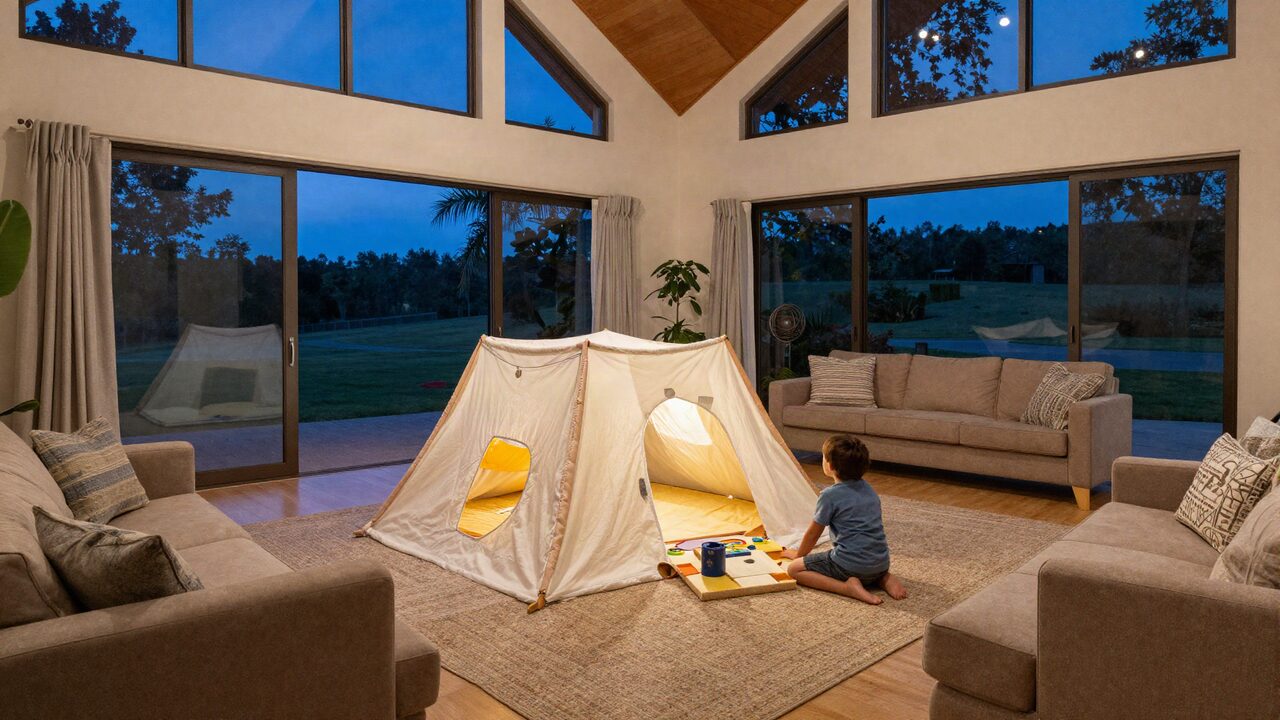
- A second living space. A den, loft or game room where kids can play while adults talk in the main room.
- A big table. Everyone at one table for dinner is the reason to share a house.
- Laundry. Snow clothes, spills and a stomach bug are easier with a washer and dryer.
- Parking. Three or four families often means three or four cars.
Look at our homes for groups for bed layouts and bedroom counts, and our family reunions page for homes that suit several generations.
Assign rooms by bedtime, not by family
Put children who go to bed early near their parents and away from the main living area, and put older cousins who stay up later together.
This is the single biggest source of friction on cousin trips. Children of different ages need different amounts of sleep. The CDC lists 10 to 13 hours, naps included, for preschoolers aged 3 to 5, 9 to 12 hours for school-age children aged 6 to 12, and 8 to 10 hours for teens aged 13 to 17. A house with a four-year-old and a fifteen-year-old has two very different evenings in it.
A simple plan:
- Little kids' bedtime. For the youngest group, set a lights-out time that suits the families with toddlers and preschoolers. Their rooms should be the quietest in the house.
- Big kids' bedtime. Older cousins get a later time, with a quiet activity (a movie, a card game) in the room farthest from the little ones.
- Adult hour. After the big kids are in their rooms, the adults get the kitchen and living room.
Write the bedtimes down and share them before the trip. Parents agree once, at home, instead of negotiating with tired children at 9pm.
Set a few house rules for kids and adults
Agree on a handful of rules before you arrive, and the trip runs on them instead of on whoever is most tired.
Each family has its own habits about screens, sugar, chores and bedtime. On a shared trip, you need a short common set. Our guide to vacation rental house rules for groups has a template; for a cousin trip, these are the ones that matter most:
- Screens. One rule for the whole house, such as screens in the shared rooms only at set times, so no child feels singled out.
- Who can discipline whose kids. Usually: any adult can stop unsafe behavior, and parents handle the rest.
- Off-limits areas. Adult bedrooms, the hot tub or pool without an adult, the garage.
- Chores. Kids clear their own plates and pick up their own gear.
- Quiet hours. Inside the house for sleeping children, and outside for the neighbors.
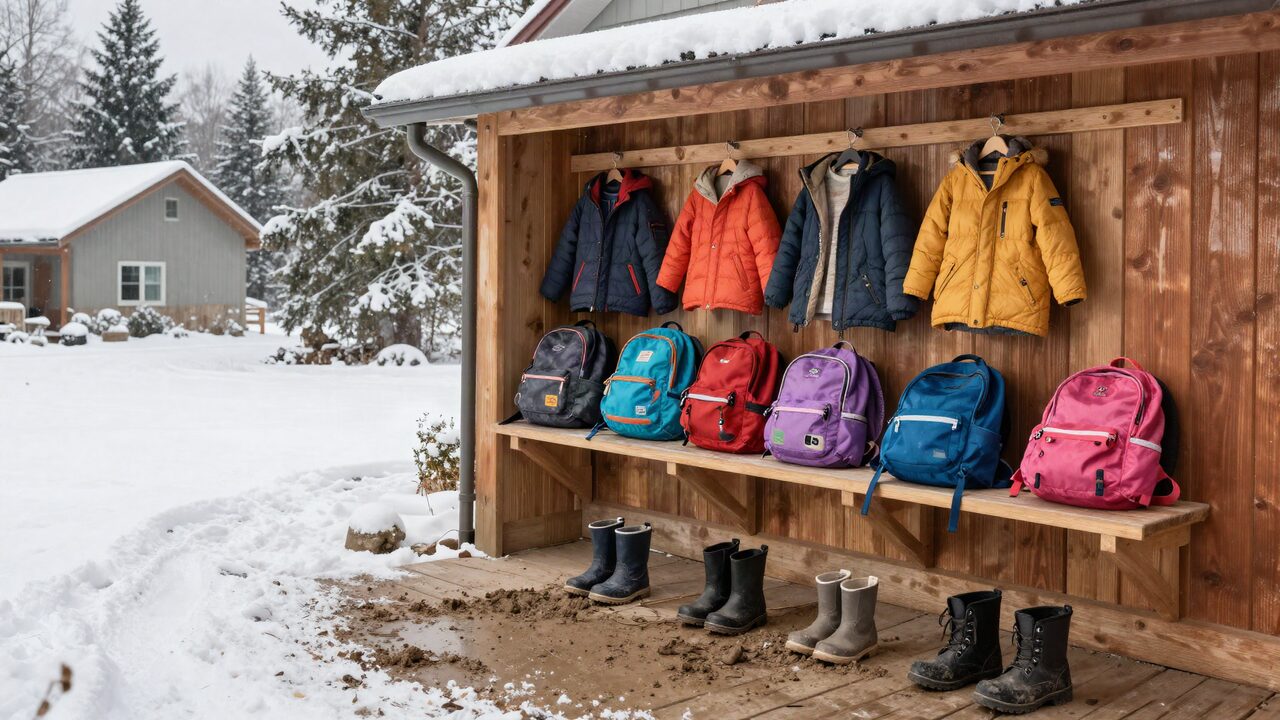
- Outdoor gear. Coats, boots and backpacks go in one place by the door, by family.
The last one sounds small. With twelve children in winter, the entryway turns into a pile of wet boots by the end of day one. A row of labeled bins or a hook per family solves it.
Plan the shared grocery run
One big shop on arrival day, from a list built in advance and paid from a shared kitty, is faster and cheaper than four families shopping on their own.
On the first afternoon, send two adults to the store with one list. Everyone else unpacks and gets the kids settled. The list should cover:
- Breakfast staples for all mornings: cereal, eggs, bread, fruit, milk, yogurt, coffee.
- Lunch and snack items that children can help themselves to.
- Ingredients for the shared dinners you planned.
- Paper goods and basics: paper towels, trash bags, dish soap, dishwasher tabs, zip bags.
Each family brings or buys its own specialty items: baby formula, allergy-safe foods, a particular coffee. That keeps the kitty fair.
For menus that scale to 15 or more, a rotation of who cooks which night and a full sample shopping list, see our group meal plan for a vacation rental. For a cousin trip, the one addition is a kids' menu night: let the cousins plan and help make one simple dinner, such as tacos or homemade pizza. It fills an evening and gives them ownership of the trip.
Agree on who covers what
Settle the money before anyone pays a deposit: how the rental is split, how food is shared, and who pays for outings.
Most money arguments on family trips come from assumptions that nobody said out loud. One family thinks the rental splits by household; another thinks it splits by person. One assumes the grandparents' share is covered; another doesn't. The fix is a short written plan.
| Cost | A common approach for several families |
|---|---|
| The rental, fees and taxes | By household, or by bedroom if rooms differ a lot |
| Shared groceries and common meals | Equal amount per adult into a kitty; children free or half |
| Family-specific food and supplies | Paid by that family |
| Outings and tickets | Each family pays for its own members who go |
| Extra nights for one family | Paid by that family |
| Pet fee | Paid by the family that brings the pet |
| A grandparent's share | Covered by the adult children, if everyone agrees |
Our guide to splitting costs on a group vacation rental explains the four main split methods, deposits and what happens if a family cancels. Use a shared expense app such as Splitwise to track the kitty, so nobody has to keep receipts in a shoebox.
Pets, gear and the first night
A little planning around pets, bulky gear and arrival makes the first evening calm instead of chaotic.
Pets. At JekkyStay homes, up to 3 pets are welcome with a $100 pet fee per stay, and service animals are free. With several families, agree how many dogs are coming so the house stays within the limit, and plan where they sleep. Our guide to a group vacation rental with dogs has more.
Gear. Pack-and-plays, high chairs, sleds, bikes and board games add up. Ask the host what the home already has, then split what's left so not every family brings a high chair.
The first night. Arrivals rarely line up. Plan a no-cook first dinner, such as pizza delivery or a big pot of soup made by the first family in, and let late arrivals eat when they get there. Show every child where their bed is before it gets dark, and where the bathroom is.
The last morning. Agree on a checkout plan the night before: who strips beds, who empties the fridge, who runs the dishwasher, who checks under the beds for lost socks and chargers.
The bottom line
Start with every family's school calendar and book the nights you all share. Choose a house with a private room per set of parents and a separate space for kids. Assign rooms by bedtime, set a few house rules, do one shared grocery run from a kitty, and write down who pays for what before anyone sends money. Browse our homes for groups to find a house with room for every cousin.
Frequently asked questions
How do we pick dates when our kids have different winter breaks?
Look up each district's official academic calendar, list the days off for every family, and book the nights all of them share. If the overlap is short, let the family with the longest break arrive first or stay later and pay for the extra nights.
How many bedrooms do three or four families need?
Plan one private bedroom per couple or single parent, then fit the children into bunk rooms or shared rooms by age. Three families with six to eight children usually fit in a five to seven bedroom home, depending on the bed layout.
How should cousins share rooms?
Group them by age and bedtime rather than by family. Little ones who go down early share a room near their parents; older cousins who stay up later share a room farther from it.
Who pays for groceries on a multi-family trip?
Most families put an equal amount per adult into a shared kitty for the big grocery run and common meals. Special items, such as one family's baby food or a particular brand of coffee, are paid by that family.
Can we bring the family dog?
At JekkyStay homes, up to 3 pets are welcome with a $100 pet fee per stay, and service animals are free. With several families, agree in advance how many dogs come so the total stays within the limit.
How long should a winter break trip with cousins be?
Four to six nights is a common fit. It gives a day to settle, a few full days together and a slow last morning, without using up a whole break that families also want to spend at home.