Quick answer
The team-building activities that work best at a company retreat are short, structured exercises tied to how the team works, plus one shared activity the house makes easy, like a cook night or lawn games. Open with a sharing exercise, use timed formats in working sessions, and keep the evenings optional.
This guide is about the activities themselves: what to run, how long each takes and how to lead them. For choosing a home, setting goals and budgeting, read how to plan a team offsite in a vacation rental first.
Key takeaways
- The best retreat activities are short, optional where possible, and tied to how the team actually works together.
- Open with a low-stakes sharing exercise, such as personal user manuals, before any hard conversation.
- Structured formats like 1-2-4-All get every voice into a working session in about 15 minutes.
- A rental house adds activities a hotel can't: a team cook night, lawn games, a fire pit evening and a game room.
- Give one person the facilitator job, timebox every activity, and avoid anything built around drinking or physical risk.
In this guide
What makes an activity work at a rental house
A good retreat activity fits the space, the time and the people. A rental house is not a conference center: you have a living room, a dining table, a kitchen and usually a yard, and nobody to reset the room between sessions.
Four tests help sort good ideas from bad ones:
- It connects to the work. The best activities help people understand how colleagues think, decide or communicate. Pure games are fine for evenings but should not fill the working day.
- Everyone can take part. Check for mobility limits, dietary needs and anyone who does not drink before you plan anything physical or food-based.
- It fits a living room. Formats that need breakout rooms can use the patio, the kitchen table and a bedroom with a door.
- It has an end time. Every activity gets a timebox, and someone holds it.
Activities at a glance
Pick two or three from this table for a two-night retreat, not all of them. Times are the typical run times, without prep.
| Activity | Best for | Time | Where in the house | Supplies |
|---|---|---|---|---|
| Personal user manuals | New or remote teams | About 90 minutes with prep | Living room | Template, laptops or paper |
| 1-2-4-All | Getting ideas from everyone | About 15 minutes | Living room, patio | Paper, pens |
| Pre-mortem | Testing a plan before launch | 45 to 60 minutes | Dining table | Sticky notes, whiteboard |
| Sticky-note gallery walk | Sorting many ideas | 30 to 45 minutes | Walls, kitchen counter | Sticky notes, dot stickers |
| Team cook night | Everyone, low pressure | 2 to 3 hours | Kitchen, grill | Groceries, recipes |
| Lawn games tournament | Mixed energy levels | 60 to 90 minutes | Backyard | Cornhole, bocce or similar |
| Fire pit or patio conversation | Reflection, the last night | Open-ended | Patio, fire pit | Prompt cards, blankets |
| Walk-and-talk pairs | One-on-one connection | 30 to 45 minutes | Neighborhood, nearby park | Comfortable shoes |
Openers for the first evening
The first evening sets the tone, so start with something that lets people share on their own terms.
Personal user manuals. Atlassian's Team Playbook describes a "My user manual" play where each person writes how they like to work: their work setup and hours, the best and worst ways to reach them, how they like to receive feedback, their top values and a proud achievement. Atlassian lists it for 3 to 10 people, with about 30 minutes of prep and about 90 minutes to run, and stresses that participation is voluntary and anyone can skip a prompt. Ask people to fill theirs in before they travel, then share them in the living room after dinner on night one. For a team larger than ten, split into two groups in different rooms.
Two good questions. If manuals feel like too much, go around the room with two prompts: "What is one thing about how you work that people get wrong?" and "What would make this retreat worth the trip for you?" Write the second set of answers on the whiteboard and come back to them on the last day.
The map. Hang a large sheet of paper and have each person mark where they grew up and where they live now. It takes ten minutes, needs no preparation, and starts conversations that carry into dinner.
Activities for the working sessions
Structured formats keep a working session moving and stop the loudest voices from deciding everything.
1-2-4-All. From Liberating Structures, this format moves a question through four rounds: about one minute of silent reflection alone, two minutes in pairs, five minutes in groups of four, then about seven minutes where a few people share the strongest ideas with everyone. The whole cycle takes about 15 minutes and works with four people or more. It is ideal for a living room, because pairs and fours can turn their chairs or move to the patio without leaving the house. Use it whenever you would otherwise ask "Any ideas?" to a silent room.
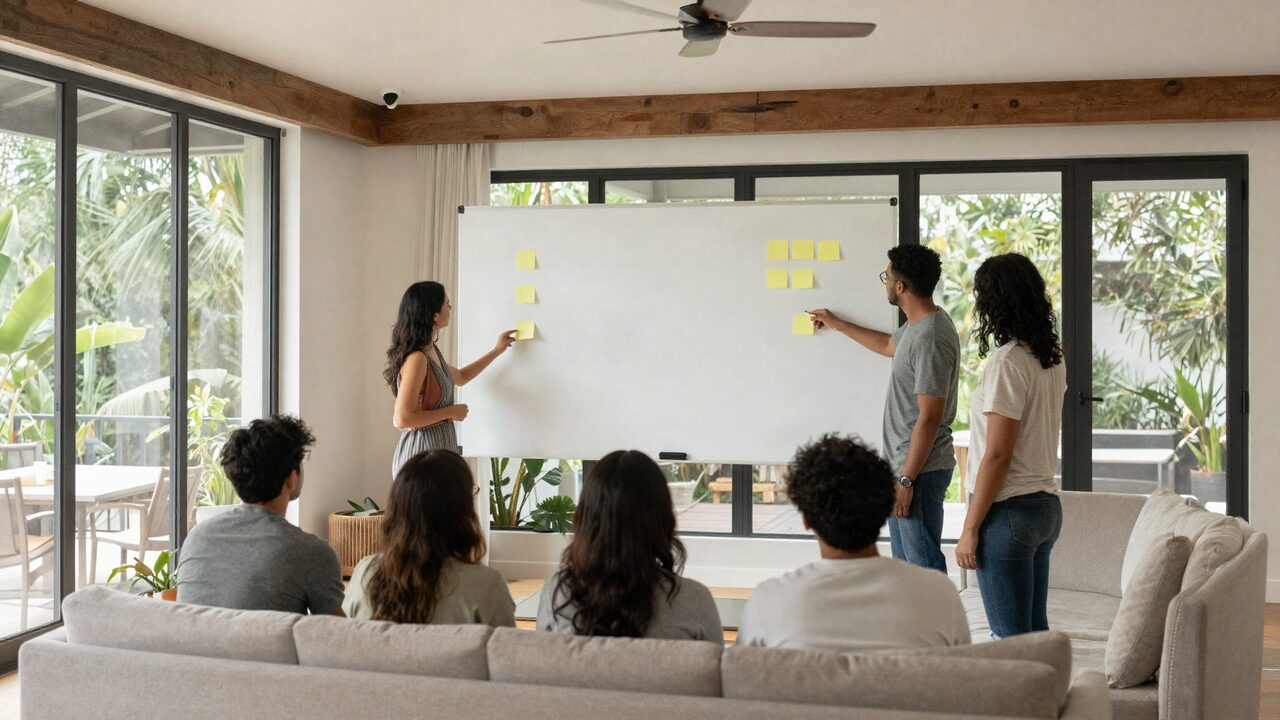
Pre-mortem. Tell the team to imagine it is a year from now and the plan you just agreed has failed. Each person writes the reasons on sticky notes for five minutes, in silence. Then group the notes on a wall and pick the three risks to act on. It is one of the fastest ways to surface doubts people have been too polite to raise.
Sticky-note gallery walk. When the team has produced more ideas than it can discuss, put them on walls or the kitchen counter, give everyone three dot stickers, and let people walk around and vote. Discuss only the top few. Bring painter's tape or removable notes, and keep notes off painted walls if the host asks.
Role swap. Pair people from different functions and have each explain the other's biggest current problem back to them. It takes about 20 minutes and is useful for teams where sales, product and operations rarely sit together.
Activities the house makes easy
The house itself is the best team-building tool you have, because it gives you shared space no meeting room offers.
Team cook night. Split the team into three groups: starters, mains and dessert. Give each group a budget, a kitchen slot and a recipe or two. Cooking side by side gets people talking in a way a restaurant table rarely does, and it is easy to adapt to dietary needs. If the house has a grill, give the mains team the grill.
Lawn games tournament. Cornhole, bocce, giant Jenga or a frisbee target work for most people and need no skill to enjoy. Make random teams of two and keep a bracket on the whiteboard. Bring the games if the house does not have them.
Game room or board game night. A home with a game room, like our Houston house, gives people a low-key option after dinner. Cooperative board games, where the whole table plays against the game, suit work teams better than cutthroat ones.
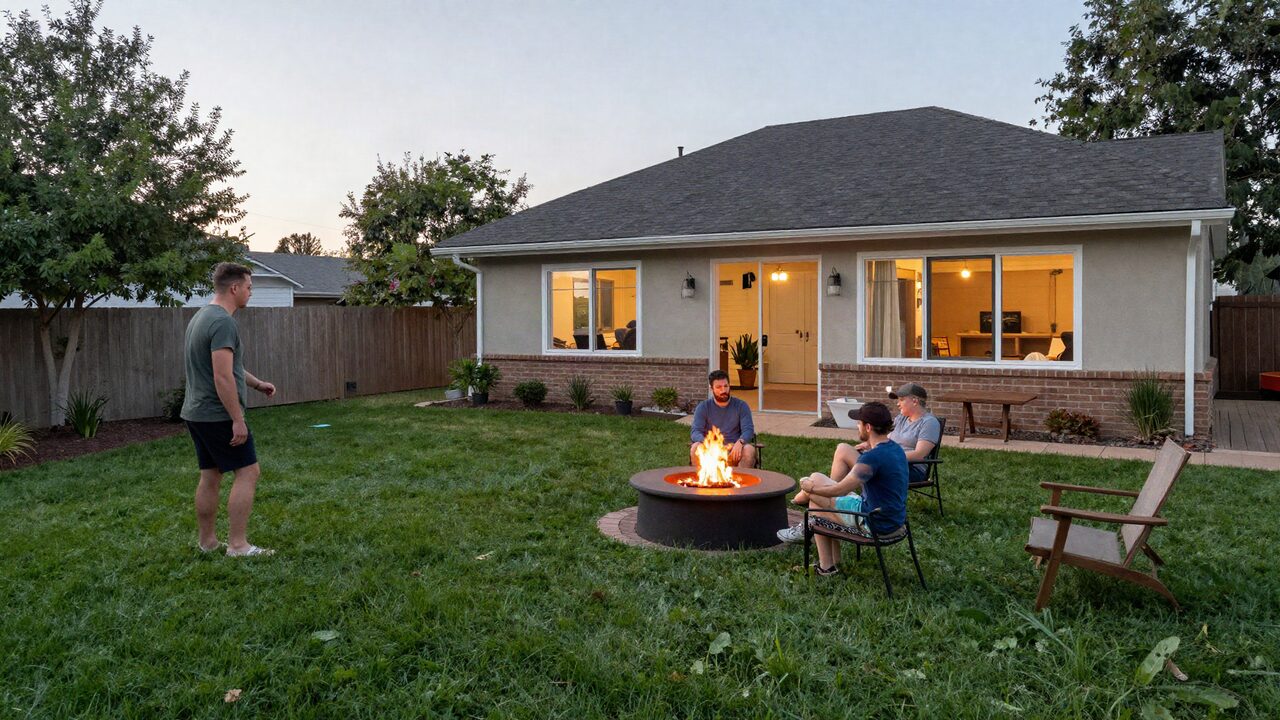
Fire pit or patio conversation. On the last night, sit outside with a few prompt cards: "What surprised you this week?" "What will you do differently on Monday?" Keep it optional and unstructured. Follow the house rules on fire pits, keep children and blankets back from the fire, and never leave it burning.
Walk-and-talk pairs. Send pairs out for a 30-minute walk with one question to discuss. People who are quiet in a group often open up side by side.
How to facilitate without a facilitator
Most small teams don't need a hired facilitator, but they do need one person whose job is to run the room.
That person:
- Owns the schedule and posts it on the fridge or the whiteboard each morning.
- Keeps time with a visible timer, and ends activities on time even when they are going well.
- Explains the rules first, including that people can pass on any sharing prompt.
- Stays neutral during discussions, or hands the role to someone else for topics they have a stake in.
- Captures outcomes on the whiteboard and photographs it before anyone erases it.
Choose someone other than the most senior person if you can. A manager running every activity tends to turn each one into a meeting. Bring in an outside facilitator when the retreat has to resolve real conflict, a reorganization or anything people will not say in front of their manager.
A sample two-day schedule
Example: a team of ten arriving Thursday evening and leaving Saturday afternoon.
| Time | Thursday | Friday | Saturday |
|---|---|---|---|
| Morning | Travel | Working session with 1-2-4-All (9 to 12) | Pre-mortem on the plan (9 to 10:30) |
| Midday | Travel | Lunch at the house | Gallery walk and decisions (10:45 to 12) |
| Afternoon | Arrive, settle in | Walk-and-talk pairs, then free time | Pack up, check out |
| Evening | Ordered-in dinner, user manuals | Team cook night, lawn games | |
| Late | Optional game night | Optional fire pit conversation |
That gives about five hours of structured work, which is plenty, and leaves space for the conversations that happen in the kitchen.
What to avoid
Some classic team-building ideas do more harm than good at a rental house.
- Drinking games or activities built around alcohol. Not everyone drinks, and it puts the host's house rules and your company's conduct policy at risk.
- Physical challenges that exclude people or risk injury, like trust falls or competitive sports for people who don't play them.
- Late, loud activities. Most homes have quiet hours and neighbors. Check the house rules for groups before planning anything after 10pm.
- A packed schedule. A retreat with no gaps leaves people tired and resentful. Free time is part of the design.
Pack a facilitation kit
A small kit turns any living room into a workshop room. Pack sticky notes in two colors, thick markers, a roll of large paper or a portable whiteboard, painter's tape, dot stickers, a timer, printed prompt cards, and lawn games if the house has none. Confirm the Wi-Fi and a screen or TV with an HDMI input if you plan to share slides.
When you are ready to choose a home, see our team retreats page, browse all stays, or read the Houston team offsite guide and how to choose a corporate retreat venue.
The bottom line
Run fewer activities and run them well. Start with a sharing exercise like personal user manuals, use timed formats such as 1-2-4-All and a pre-mortem in working sessions, and save one evening for something the house makes easy, like a cook night or lawn games. Give one person the facilitator job, keep evenings optional, and skip anything that depends on drinking or puts people on the spot.
Frequently asked questions
What are good team-building activities for a small company retreat?
For a team of six to fifteen, mix a sharing exercise on the first evening (such as personal user manuals), structured idea formats during working sessions (such as 1-2-4-All or a pre-mortem), and one shared activity at the house, like a cook night, lawn games or a walk.
How long should a team-building activity take?
Most work best between 15 and 90 minutes. Atlassian's user manual play, for example, runs about 90 minutes with prep; 1-2-4-All takes about 15. Anything longer tends to lose people unless it is a meal or an outing.
Do we need a professional facilitator?
Not for most small-team retreats. Pick one person to run the schedule, keep time and stay neutral during discussions. Consider an outside facilitator when the retreat has to resolve conflict or a major reorganization.
Should team-building activities be mandatory?
Keep the working sessions expected and the evening activities optional. Forced fun breeds resentment, and people who skip the lawn games often join the conversation at dinner instead.
What team-building activities should we avoid?
Avoid activities that depend on alcohol, single people out, require physical ability some people lack, or ask for personal disclosures people did not agree to. Trust falls and drinking games are the usual examples.
Can we use the house's fire pit or hot tub for team activities?
Check the house rules first. Many homes allow both with conditions, such as quiet hours or no glass near the hot tub. Treat them as optional downtime rather than a scheduled activity.